

The Multilingual AI Glossary The Multilingual AI Glossary
A working dictionary for the terms, frameworks, and vendor concepts reflecting how AI translates, generates, evaluates, and governs multilingual content.
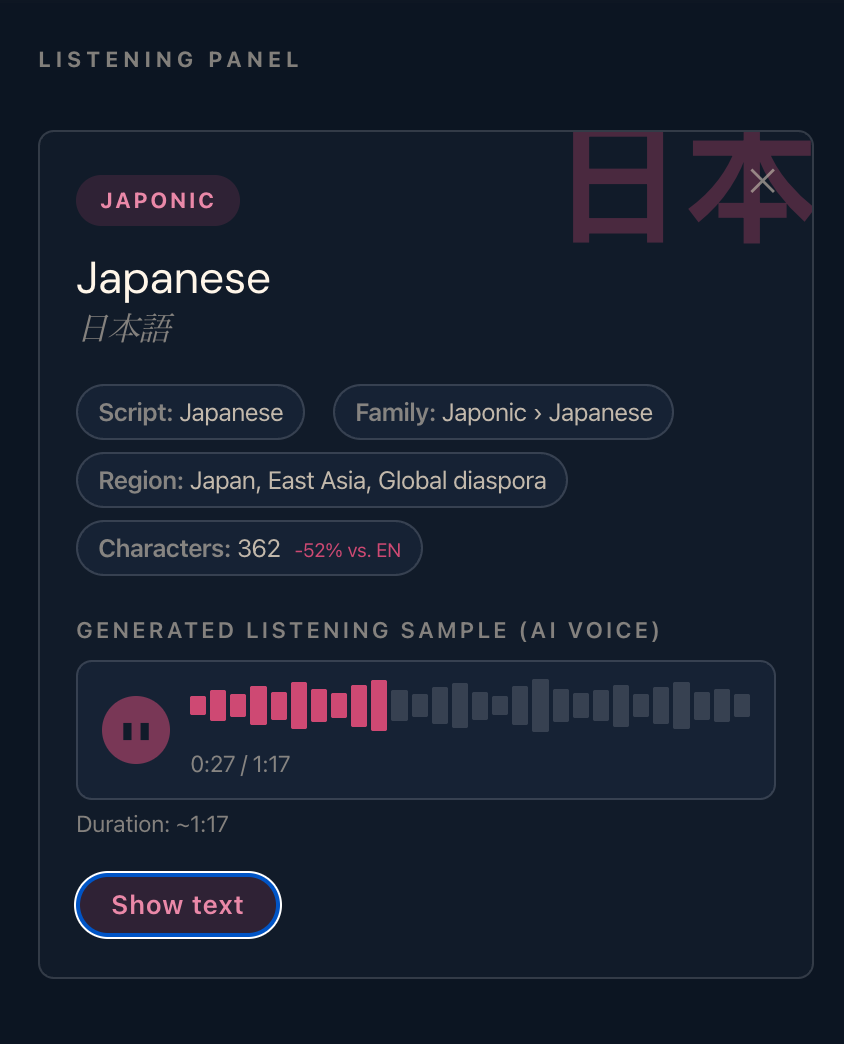
The Sound of Multilingual AI: Listening Gallery The Sound of Multilingual AI: Listening Gallery
There’s one thing we don’t often talk about in the language industry: the beauty of languages. And nothing reveals their beauty better than when they’re spoken. Written text can hide, pretend, mislead. And it often does. Spoken words, less so.
![What does AI actually read? [Interactive Dashboard]-featured](https://multilingual.ai/hubfs/Newsletter/lang-hero-shapes.png)
What does AI actually read? [Interactive Dashboard] What does AI actually read? [Interactive Dashboard]
What does AI actually read? Mostly the open web. And Common Crawl, the page-by-page archive that sits at the foundation of GPT, LLaMA, Gemini and other major language models, looks nothing like the world that speaks. Hindi: 610 million speakers, 0.22% of pages; three percent of the rate it is spoken. Bengali sits at the same ratio. English is 41% of pages, falling slowly. The training data that shapes how machines understand language is wildly uneven. Eight years of snapshots, 29 languages,...

AI as Alibi AI as Alibi
Companies have attributed some 80,000 layoffs in tech alone to AI year-to-date. Sure, just a fraction of the 8.8 million jobs lost in the broader financial crisis that followed the collapse of Lehman Brothers in 2008. But still a significant number. And one that's growing.
AI Search Has a Language Problem. Localization Has the Answer. AI Search Has a Language Problem. Localization Has the Answer.
AI search and localization are starting to overlap. AEO (Answer Engine Optimization) is described as optimizing content so AI systems cite it or feature it in direct answers across tools such as ChatGPT, Google AI Overviews, Perplexity, and Copilot. But for global companies, that definition is incomplete unless it includes language.
.png)
The Future Head of Localization is an IC (Again) The Future Head of Localization is an IC (Again)
Last week I read Elena Verna’s newsletter on high-impact IC work. I kept nodding. Elena’s thesis is about tech and growth, but essentially the same is happening in localization too. We may be entering an era where a senior, high-leverage individual contributor (IC) can own a much larger slice of localization end-to-end than was practical over the last two decades. Not everywhere, and it’s not for everyone, of course. But in the right contexts, it’s becoming a real operating model, not just a...