

AI search and localization are starting to overlap. AEO (Answer Engine Optimization) is described as optimizing content so AI systems cite it or feature it in direct answers across tools such as ChatGPT, Google AI Overviews, Perplexity, and Copilot.
But for global companies, that definition is incomplete unless it includes language.
A buyer may ask in French about an English-language SaaS vendor. A German procurement team may ask about a US platform using local category terms. A Japanese marketer may ask for alternatives to a tool whose strongest sources are in English. In each case, the answer engine has to bridge language, entity, terminology, source authority, and market context.
AI answers are localized content, whether you like it or not.
You haven’t briefed it. You may not have reviewed it. You may not have approved the terminology. You may not even know which sources it used. But from the buyer’s perspective, the answer still shapes perception.
If you lead localization (or work closely with it), this is an AI search problem you will increasingly be asked to solve, whether or not the SEO or growth team thinks it belongs to you at the moment. So it pays off to be proactive.
What actually happens inside an answer engine
Traditional search gives users a list of links. AI search gives users a synthesized answer.
Answer engines do not always behave like classic search engines. Some rely on live web retrieval. Some use cached indexes. Some combine model memory with search results. Some cite many sources. Some cite only a few. Some directly summarize without visible citations.
It is not enough that your English page ranks. It is not enough that your German page exists. It is not enough that your product messaging has been so cleverly translated. The AI system has to connect the buyer’s question to the right concept, connect the concept to the right sources, connect the sources to the right entity, and generate the answer in a way that preserves meaning.
Localization managers know exactly how fragile that chain can be.
That means global visibility is no longer just about whether a page ranks. It is about whether the right source, in the right language, can be retrieved and safely reused in an answer.
Here’s what often goes into commercial LLMs, and what it means for localization.
| Step | What happens | Why localization teams should care |
|---|---|---|
| Pretraining | The model absorbs language, facts, entities and associations from large corpora. | If your brand, category, and terminology are inconsistent across the web, the model may learn a weak, outdated, or English-centric version of who you are. |
| Instruction tuning | The model is trained to answer in helpful, structured and safe formats. | Clear, factual, direct explanations are more likely to survive compression into an AI-generated answer. |
| Retrieval / RAG | The system retrieves current or authoritative sources before answering. | Your multilingual content must be indexable, extractable, trusted and connected to the right entities. |
| Reranking / source selection | Candidate sources or passages are filtered for relevance, authority, freshness, and usefulness. | Traditional SEO still matters, but passage-level clarity, terminology and local authority matter too. |
| Generation and citation | The LLM synthesizes an answer and may cite sources, mention brands or summarize categories. | The final answer becomes localized content about your company, whether or not your team reviewed it. |
In terms of cross-language use, some systems translate the query or source. Some retrieve directly across languages using multilingual embeddings. Some combine keyword retrieval, semantic retrieval, reranking, and LLM synthesis.
Each path can work, and each path can fail. Translation can distort named entities. Multilingual embeddings can miss exact terminology. Rerankers can prefer sources that are clearer or more authoritative, even if they are not your owned pages.
For multilingual AEO, you are not just optimizing content. You are optimizing whether an answer engine can resolve the right entity, in the right language, with the right terminology, from sources it trusts.
Let’s say a buyer asks a simple question like “What is the best AI CRM for small business in Germany?” This may trigger query expansion, cross-language retrieval, source selection, and answer generation before the buyer sees a recommendation.
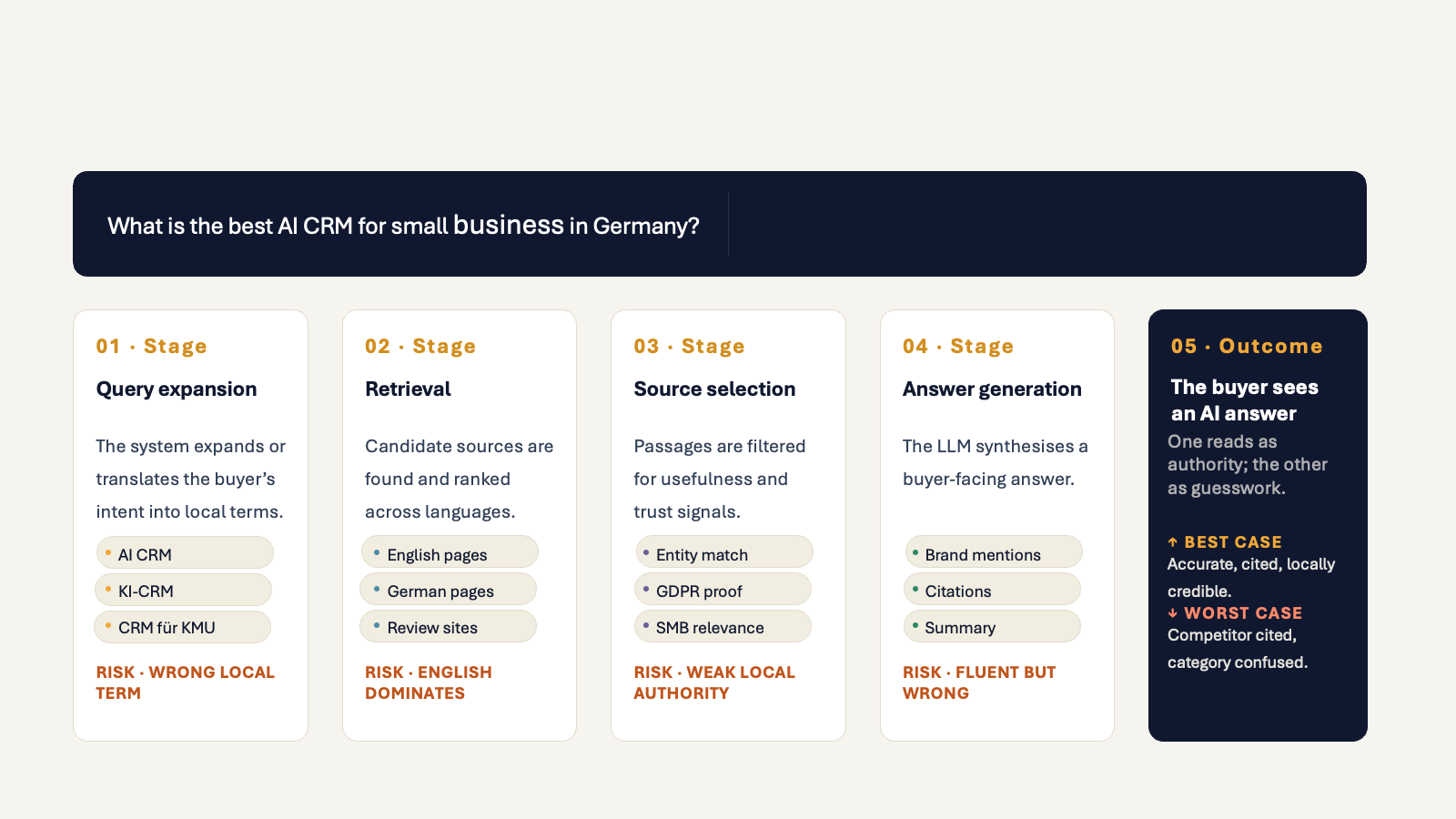
At every stage, localization choices affect the outcome: whether the system maps “small business” to the right local-market concept, whether it understands “AI CRM” as a category, whether it retrieves German sources or defaults to English, and whether the final answer sounds credible to a German buyer.
The multilingual problem is not solved
There is a common assumption in marketing right now: because LLMs can respond in many languages, they are truly multilingual.
That is only partly true.
Many commercial LLMs are impressive multilingual interfaces. They can detect language, translate, summarize, and answer in dozens of languages. But being able to produce fluent text in a language is not the same as having equal knowledge, equal retrieval quality, equal reasoning reliability, or equal entity understanding across languages.
If a model knows something about your brand in English, that does not guarantee it can answer accurately in other languages. If your product category is well established in one market, that does not mean the equivalent category exists in the same way in another. If your competitors are well described in third-party sources and you are not, the answer engine may reproduce that imbalance globally.
Localization teams have lived with this reality for years. Meaning does not transfer automatically. Context matters. Terminology matters. Domain conventions matter. Local buyer expectations matter. Some concepts have no clean equivalent. Some terms are overloaded. Some markets use English loanwords. Some require transcreation. Some require explanation before translation.
The same is now true for AI search.
Alles CLAR: Cross-Language Answer Retrieval
This is the problem I’m tempted to name CLAR: Cross-Language Answer Retrieval: making brand, product, and domain knowledge retrievable by AI answer engines across languages, so LLMs can cite, synthesize, and represent it accurately.
Translation helps, but it doesn’t solve how models can produce wrong or distorted answers across languages. Such as:
- Semantic drift: meaning shifts as queries are translated, embedded, summarized, and compressed.
- Entity misalignment: the system fails to recognize the same company/product/category across languages and scripts, especially when names are transliterated or locally described.
- Domain vocabulary mismatch: a literal translation can be linguistically correct but commercially invisible if local buyers use different category language.
- Source selection dynamics: answer engines often prefer the clearest, most authoritative passages, even when those are not your owned pages.
If CLAR is real (and I think it is), then localization has a new kind of asset to build: not only translated pages, but retrieval-ready meaning across languages.
Why translation alone will not solve AI search
The instinctive response from many global marketing teams will be simple: take the AEO content from English, translate it into priority languages, add hreflang, and happily move on.
But that will not be enough. Translation helps, of course, but the hard part is ensuring the right concept can be retrieved and represented when the user crosses language boundaries.
Here are common pitfalls.
The category does not map cleanly. A SaaS category that is common in the US may not have the same market vocabulary in Germany, Japan, or Brazil. A literal translation may be technically correct but commercially invisible.
The buyer uses different questions. English-language SEO data may not reflect how local buyers ask AI for advice. The same need can appear as a different prompt, a different pain point, or a different comparison set.
The model retrieves English anyway. If the English source is stronger, more linked, more cited, or better structured, the answer engine may rely on it even when answering in another language. That can be useful, but it can also erase local market nuance.
The answer flattens differentiation. AI-generated answers often omit detail. If your differentiation depends on specific terminology, industry proof, or complex positioning, the answer may reduce you to a generic category player.
The cited sources are not yours. AI systems may cite review platforms, media, documentation, partner pages, competitor content, or community discussions. If those sources do not describe you well, your owned content may not control the answer.
Low-resource languages receive weaker treatment. Less training data, fewer local sources, weaker machine translation, and fewer authoritative references can all reduce answer quality. This is especially important for global companies that treat “Tier 2” and “Tier 3” languages as lighter localization tasks.
Localization managers will recognize the pattern. Quality problems rarely come from a single bad sentence. They come from broken systems: weak source content, missing context, inconsistent terminology, poor review loops, and unclear ownership.
AI search has the same problem.
Localization as the essential layer for global AI search
This is where localization managers can step into a more strategic role.
The AI search conversation inside many companies will initially be owned by SEO, content, or marketing/growth teams. They will build prompt lists, track citations, restructure pages, and monitor competitors.
That is useful, but definitely incomplete.
Without localization, AEO may become English-centric very quickly. It measures what answer engines say in English, about English queries, using English sources, for an English-speaking buyer. Then it assumes the global problem is mostly solved. And we know it’s not.
Localization teams can become the essential “trust” layer for global AI search. They can validate whether answer engines are preserving meaning across languages. They can help build multilingual glossaries that support both human translation and machine retrieval. They can push for local-market proof, not just translated global claims. They can help marketing teams understand that answer accuracy is not the same thing as fluent output.
This is not a defensive role. It is an expansive one. Localization can move from downstream production to upstream knowledge strategy.
What this means for localization leaders
If you lead localization, this is a moment to broaden the conversation.
The question is no longer only: how do we localize content faster or cheaper? It is also: how do we make sure AI systems can answer correctly about us in every market and every language that matters?
That opens new opportunities for localization leaders.
You can bring market intelligence into AEO. You can turn terminology into a strategic retrieval asset. You can help define what “answer accuracy” means by language. You can create review loops for AI-generated answers. You can identify where English-centric content strategies totally fail locally. You can help marketing teams see that multilingual visibility is not just a traffic problem. It is a meaning problem.
After all, localization has always been in the business of meaning, more than anything else.
A practical way to frame the conversation internally
If your marketing team is starting to talk about AEO, GEO, AI search, zero-click search, or answer visibility, and I’m sure they are, localization should not wait to be invited to the table at the very end.
Here’s the framing you can use:
“AI search is creating localized answers about our brand whether we manage them or not. If we want to be visible globally, we need to make our knowledge retrievable across languages, not just translate our webpages. Localization can help ensure that answer engines use the right terminology, retrieve the right sources, preserve the right meaning, and represent us accurately in each market.”
That is the essence of CLAR.
Final thought
For years, localization teams have been asked to adapt content after strategy has already been set. But AI search changes the sequence.
The companies that win global AI search will be the ones that make their knowledge easiest to retrieve, safest to cite, and hardest to misunderstand across languages.
AI search is a brand-new opportunity for localization that would be a shame to miss.